All articles
WorkplaceDec 9, 2025 · 5 min
Designing workplaces for 40% headcount growth
The fit-out that outlives its brief is the one that refused to be finished. A modular strategy that flexes without re-fit.
 ARCSPACEXDESIGN · STUDIO
The fit-out that outlives its brief is the one that refused to be finished. A modular strategy that flexes without re-fit.
Every growth-stage client we meet tells us the same thing: "we'll be this size for three years". Every one of them is wrong. The fit-out that lasts is the one that plans for the brief nobody will admit to — 40% more people than the day of move-in.
Here's how we design for it without spending 40% more on day one.
When a workplace gets tight, three things fail in sequence:
Solve these in reverse order and you buy 12 months of runway. Solve them in the right order and you buy three years.
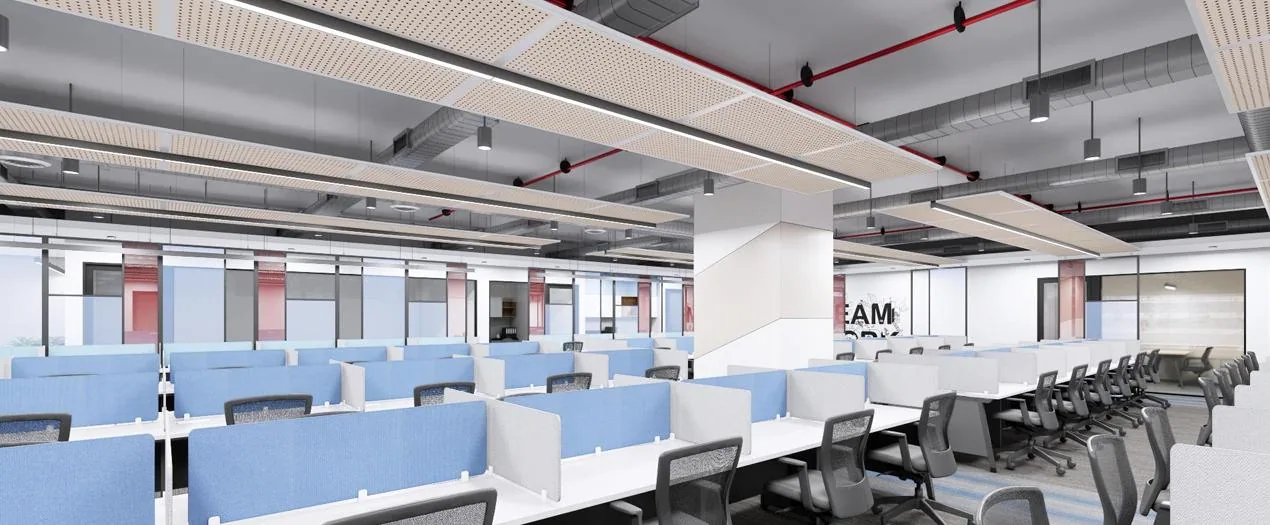
Our default approach is a modular neighbourhood pattern — clusters of 8 to 12 desks, each with its own soft-seating huddle and one small closed meeting room. You can add a neighbourhood without touching the others. You can shrink a neighbourhood without orphaning its meeting room.
The trick is that the neighbourhood boundary has to be slightly oversized at move-in — by about 15%. That empty edge doesn't feel wasteful because it's absorbed into circulation. But when headcount jumps, that edge absorbs two more desks per cluster without moving a partition.
15% oversized × a well-planned neighbourhood structure = roughly 40% runway before any rebuild.
The second move is demountable partitions on every closed room that isn't a wet area. Glass-framed partitions with unistrut tracks in the ceiling can be re-laid in a weekend. Combined with a modular ceiling grid (not a monolithic pop-out), a meeting room that's two desks wide on Friday can be three desks wide on Monday.
This is cheaper to build than it sounds — roughly 18–22% premium over monolithic drywall — and saves the entire cost of a refit 18 months later.
The third move is to treat furniture as infrastructure. Workstations come in two sizes, one colour, one family. Chairs come in one spec. Meeting rooms share tables and screens from a standard kit. When you add 40 desks, they slot into the existing language with zero procurement delay and zero visual disruption.
The counter-move — "let's do every neighbourhood in a different material" — looks great in the first photo and becomes a procurement nightmare in month 14.
A growth-ready fit-out costs about 6–9% more upfront than a minimum-viable one. It saves the equivalent of a full re-fit at month 18 — roughly 35–40% of the original project cost, plus three to five months of disruption.
The math is obvious. The discipline — to resist the temptation to fill every sqft on day one — is what's hard. That's the part clients hire a studio for.
Planning a space that has to flex? Tell us your growth horizon and we'll show you what the plan would look like.
09 / Begin
From the first conversation to the zero-snagging handover — one accountable team, one contract, one standard.